
A Practical Guide for Commercial Buildings
- Introduction – What Are Lighting Controls in Commercial Spaces?

Lighting controls are intelligent systems used to manage, automate, schedule, dim, and optimize lighting within commercial buildings. These systems regulate lighting operation based on occupancy, daylight availability, time schedules, energy demand, and user preferences.
In commercial environments such as office towers, retail facilities, warehouses, educational institutions, healthcare facilities, and mixed-use developments, lighting controls are now considered an essential component of building infrastructure.
Modern lighting controls provide several operational benefits:
- Reduced electrical consumption
- Enhanced occupant comfort
- Improved building sustainability
- Compliance with Canadian energy codes
- Centralized building management
- Increased tenant satisfaction
- Improved maintenance visibility
Lighting controls can range from simple wall dimmers and occupancy sensors to fully networked building-wide lighting ecosystems integrated with HVAC, security, and Building Automation Systems (BAS).
As lighting technology evolves, commercial buildings increasingly rely on intelligent controls to meet energy efficiency mandates, ESG goals, and tenant expectations.
- Lighting Control Systems – From Small to Large Applications
Lighting control systems vary depending on building size, occupancy type, and operational complexity.
Small Commercial Applications
Examples:
- Retail stores
- Small offices
- Restaurants
- Clinics
Typical controls include:
- Manual switches
- Occupancy/vacancy sensors
- Wall-box dimmers
- Standalone timers
- Daylight harvesting sensors
Advantages:
- Lower installation cost
- Simpler programming
- Easy maintenance
Disadvantages:
- Limited scalability
- Minimal integration capability
- Reduced energy analytics
Medium Commercial Applications
Examples:
- Multi-floor offices
- Schools
- Warehouses
- Mid-sized commercial plazas
Typical controls include:
- Zoned lighting controls
- Networked relay panels
- Central scheduling systems
- 0–10V dimming
- DALI systems
Advantages:
- Better energy optimization
- Centralized management
- Improved scheduling flexibility
Disadvantages:
- Increased commissioning requirements
- More complex wiring infrastructure

Large Commercial and High-Rise Applications
Examples:
- Commercial office towers
- Airports
- Hospitals
- Universities
- Multi-tenant developments
Typical controls include:
- Fully addressable lighting networks
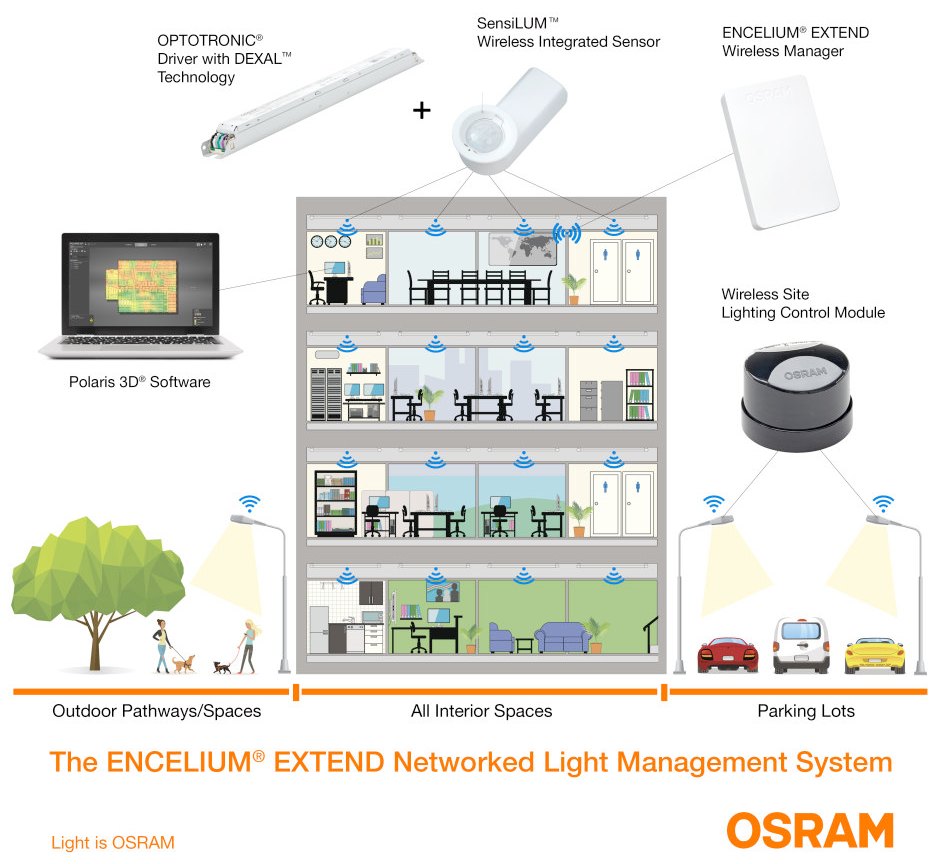
- Wireless mesh systems
- Building-wide dashboards
- BAS integration
- POE lighting systems
- Cloud-based analytics
Advantages:
- Maximum energy efficiency
- Enterprise-level monitoring
- Flexible tenant control
- Scalable infrastructure
- Advanced reporting capabilities
Disadvantages:
- Higher upfront costs
- Requires specialized commissioning
- Greater IT coordination
- Current Lighting Control Technologies
Wired Lighting Controls
Wired systems remain the most common in commercial construction due to reliability and long-term stability.
Operation:
- Signals travel through physical cables.
- Switches and sensors control lighting directly.
Benefits:
- Reliable communication.
- Fast response times.
- Strong security.
Limitations:
- Higher installation costs.
- Difficult to expand or modify.
0–10V Dimming
0–10V dimming is one of the most widely used analog dimming protocols in North America.
Operation:
- 0V = minimum light level/off
- 10V = full brightness
Benefits:
- Cost-effective
- Simple implementation
- Compatible with many LED drivers
Limitations:
- Limited feedback capability
- Requires additional low-voltage wiring
DALI (Digital Addressable Lighting Interface)
DALI is a digital communication protocol used for intelligent lighting control.
Features:
- Individual fixture addressing
- Two-way communication
- Scene setting
- Diagnostics and monitoring
Advantages:
- Excellent flexibility
- Scalable architecture
- Precise dimming control
Disadvantages:
- Higher commissioning complexity
- Increased programming requirements
DALI-2 is now becoming the industry standard due to improved interoperability between manufacturers.
Wireless Lighting Controls
Wireless systems eliminate or reduce control wiring and are ideal for retrofits while offering the same control as a wired solution- with the potential for future-proofing your solution.
Technologies include:
- Bluetooth Mesh
- Zigbee
- EnOcean
- Wi-Fi-based systems
Advantages:
- Reduced installation cost
- Easier renovations
- Flexible reconfiguration
Disadvantages:
- Potential interference
- Battery maintenance
- Cybersecurity considerations
Wireless controls are increasingly popular in tenant improvement projects and retrofit applications.
Power over Ethernet (POE) Lighting
POE lighting delivers both power and data through Ethernet cabling without the need for electrical wiring throughout.
Benefits:
- Simplified infrastructure
- Integration with IT networks
- Advanced analytics
- Centralized device management
Applications:
- Smart buildings
- High-tech offices
- IoT-enabled facilities
Limitations:
- Requires IT collaboration
- Higher initial design coordination
POE is expected to grow significantly as commercial buildings evolve toward smart-building ecosystems.
Emerging Technologies
Li-Fi
Uses light waves for wireless data transmission.
Cloud-Based Lighting Platforms
Remote monitoring and software-driven building management.
Human-Centric Lighting
Adjusts colour temperature and intensity to support occupant wellness and circadian rhythms.
AI-Driven Lighting Analytics
Uses occupancy trends and predictive maintenance analytics to optimize operation.
- Building Scope – Single Tenant vs Multi-Tenant Towers
Single Tenant Buildings
Advantages:
- Unified operational requirements
- Easier scheduling coordination
- Simplified control architecture
Disadvantages:
- Less flexibility if occupancy changes or subdivided
- Single stakeholder decision-making may delay upgrades
Multi-Tenant Commercial Towers
Advantages:
- Independent tenant control
- Centralized landlord oversight
- Enhanced energy metering opportunities
Disadvantages:
- Greater commissioning complexity
- More extensive IT and security coordination
- Tenant customization challenges
Centralized vs Distributed Systems
Centralized Systems
A centralised lighting control system uses one main controller to manage all lighting devices, schedules, and settings in a building. It is commonly used in large facilities because it simplifies monitoring, maintenance, and energy management. A decentralised system uses multiple local controllers, sensors, or lighting zones that operate independently. This provides greater flexibility, easier expansion, and improved reliability if one area fails.
Pros:
- Easier building-wide management
- Central reporting
- Simplified energy monitoring
Cons:
- Larger single-point failures
- Higher infrastructure cost
Distributed Systems
Pros:
- Better scalability
- Reduced operational disruption
- Improved flexibility
Cons:
- More devices to maintain
- Greater network management requirements
5. Selecting the Optimal Lighting Control System
Key Evaluation Criteria
Building Size
Larger buildings typically benefit from networked systems – Wired or Wireless.
Tenant Flexibility
Multi-tenant spaces require adaptable zoning and scheduling.
Energy Goals
Projects pursuing LEED, WELL, or ESG targets often require advanced controls.
Budget
Balance capital cost versus operational savings.
Integration Requirements
Determine whether the lighting system must communicate with:
- BAS systems
- HVAC
- Security systems
- Utility demand response programs
Future Expansion
Select scalable systems capable of supporting future renovations and technology upgrades.
- Commissioning and Programming
Commissioning ensures that the lighting control system operates according to design intent. Ongoing scheduled updates and re-balancing/optimization is required.
Commissioning activities include:
- Device addressing
- Sensor calibration
- Time scheduling
- Scene programming
- Occupancy tuning
- Daylight harvesting setup
- Emergency override verification
Understanding Lighting Behaviour
Commissioning teams must understand:
- Occupancy patterns
- User expectations
- Daylight contribution
- After-hours operation
- Tenant overrides
Poor commissioning is one of the largest causes of occupant dissatisfaction.
Reverting to Default Settings
Most modern systems allow:
- Backup configurations
- Factory reset options
- Cloud-based restoration
- Recommissioning templates
Proper documentation is critical to long-term operational success.
7. Increasing Tenant Buy-In
Tenant adoption is essential for successful lighting control implementation.
Strategies to Improve Acceptance
Provide User Simplicity
Interfaces should remain intuitive and easy to operate.
Offer Personal Control
Allow tenants to adjust lighting within approved limits.
Demonstrate Energy Savings
Provide energy dashboards and reporting.
Enhance Comfort
Demonstrate benefits of tunable white and daylight integration.
Reduce Complaints
Proper sensor tuning prevents nuisance shutoffs.
Tenant engagement significantly improves long-term system effectiveness.
- Top 5 Benefits of Commercial Lighting Controls
1. Energy Savings
Lighting controls can reduce lighting energy consumption by 30–70%.
2. Improved Occupant Comfort
Customized scenes and daylight integration improve workspace quality.
3. Reduced Maintenance Costs
Automated diagnostics help identify failures quickly.
4. Sustainability Compliance
Supports ESG initiatives, LEED certification, and carbon reduction goals.
5. Operational Flexibility
Allows facility managers and tenants greater control over building environments.
- Updating building environment
In order to stay competitive in the commercial rental market, buildings have to upgrade spaces with the most innovative lighting controls.
9. Codes, Standards, Rebates, and Industry Requirements
Canadian Standards and Codes
CSA Standards
The Canadian Standards Association (CSA) governs electrical safety and installation standards.
Relevant standards include:
- CSA C22.1 Canadian Electrical Code
- CSA lighting equipment standards
ASHRAE Standards
ASHRAE 90.1 establishes minimum energy efficiency requirements for buildings.
Lighting control requirements include:
- Occupancy sensing
- Automatic shutoff
- Daylight harvesting
- Scheduling controls
ASHRAE standards strongly influence Canadian building design practices.
National and Provincial Energy Codes
National Energy Code of Canada for Buildings (NECB)
NECB includes mandatory lighting power density and automatic control requirements.
Provincial adaptations may vary.
Here are several important Canadian federal and provincial codes and standards that address commercial lighting controls, energy efficiency, occupancy sensors, automatic shutoff requirements, daylight harvesting, and lighting power density limits.
Federal / National Codes
- National Energy Code of Canada for Buildings (NECB) 2020
The NECB is Canada’s primary model energy code for commercial buildings. It includes requirements for:- Automatic lighting shutoff controls
- Occupancy sensors
- Daylight-responsive controls
- Exterior lighting scheduling
- Maximum lighting power density allowances
Useful links:
- https://nrc.canada.ca/en/certifications-evaluations-standards/codes-canada/codes-canada-publications/national-energy-code-canada-buildings-2020
- https://nrc.canada.ca/en/certifications-evaluations-standards/codes-canada/codes-canada-publications/national-energy-code-canada-buildings-2015
- National Building Code of Canada (NBC)
While the NBC mainly addresses life safety and construction requirements, it also references emergency lighting, exit illumination, and integration with electrical systems and controls. Provinces often adopt portions of the NBC into their own building codes.
Ontario Provincial Requirements
- Ontario Building Code (OBC) – SB-10 Energy Efficiency
Ontario adopts commercial energy efficiency requirements through Supplementary Standard SB-10, which references NECB-style performance requirements for Part 3 buildings. SB-10 includes:- Automatic lighting shutoff requirements
- Occupancy sensor requirements
- Lighting power density limits
- Control zoning requirements
This is one of the most important standards for commercial lighting controls in Ontario.
Useful link:
- Ontario Electrical Safety Code (OESC)
The OESC governs electrical installation requirements for lighting control systems, including:- Wiring methods
- Low-voltage lighting controls
- Emergency lighting circuits
- Separation of Class 1 and Class 2 control wiring
- Installation safety requirements for lighting automation systems
Useful link:
Industry Standards Commonly Referenced in Canada
- ASHRAE 90.1 – Energy Standard for Buildings Except Low-Rise Residential Buildings
Many Canadian jurisdictions and consultants reference ASHRAE 90.1 for lighting control design guidance. It includes detailed requirements for:- Occupancy sensing
- Time scheduling
- Daylight harvesting
- Automatic receptacle and lighting controls
- Exterior lighting control strategies
Useful link:
- IES Lighting Standards (Illuminating Engineering Society)
IES standards are widely used alongside Canadian codes to determine proper lighting levels and control strategies for offices, schools, warehouses, healthcare facilities, and exterior spaces.
Useful link:
These codes and standards collectively drive the adoption of modern lighting control strategies in Canada, including LED dimming systems, occupancy sensors, daylight harvesting, centralized building automation
Utility Incentives and Rebates
Canadian utility providers often provide incentives for:
- LED retrofits
- Occupancy sensors
- Networked lighting controls
- Advanced energy management systems
Examples include:
- Hydro One
- Toronto Hydro
- BC Hydro
- Hydro-Québec
- Efficiency Manitoba
- Save on Energy (Ontario)
Programs change frequently and should be reviewed during project planning.
LEED and WELL Building Standards
Lighting controls contribute toward:
- LEED certification points
- WELL occupant wellness criteria
- ESG reporting initiatives
Human-centric lighting and energy analytics are increasingly important in premium commercial developments.
10. Recommended Podcasts and Industry Resources
- Light Talk Podcast
Official website:
https://lighttalk.libsyn.com/ - The Lighting Controls Podcast
Apple Podcasts:
https://podcasts.apple.com/ca/podcast/lighting-controls-podcast/id1647569792
YouTube Channel:
https://www.youtube.com/@thelightingcontrolspodcast - Today’s Lighting Designer
Website:
https://www.todayslightingdesigner.com/ - Lighting Matters
Apple Podcasts:
https://podcasts.apple.com/ca/podcast/lighting-matters/id1756267809 - The Luminous Podcast
Website:
https://www.luminouspodcast.com/
Industry Organizations and Resources
- Illuminating Engineering Society (IES)
- Lighting Controls Association (LCA)
- National Electrical Manufacturers Association (NEMA)
- ASHRAE
- CSA Group
Recommended websites:
11. Glossary of Lighting Control Terms
BAS
Building Automation System.
DALI
Digital Addressable Lighting Interface.
Daylight Harvesting
Automatically dimming lights based on available daylight.
Demand Response
Reducing building energy use during utility peak periods.
Fixture Addressing
Assigning digital identification to lighting fixtures.
Human-Centric Lighting
Lighting designed to support wellness and circadian rhythms.
IoT
Internet of Things.
Occupancy Sensor
Detects movement to automatically control lighting.
POE
Power over Ethernet.
Scene Control
Preset lighting configurations for specific activities.
Vacancy Sensor
Requires manual ON operation but automatic OFF.
Zigbee
Wireless mesh communication protocol.
0–10V Dimming
Analog dimming protocol commonly used for LED drivers.
Conclusion
Commercial lighting controls are now a foundational component of modern building infrastructure. As commercial buildings evolve toward smart-building ecosystems, lighting controls continue to play a critical role in energy conservation, occupant wellness, operational efficiency, and tenant satisfaction.
For developers, consultants, contractors, and building owners across Canada, selecting the right lighting control strategy requires balancing technology, scalability, usability, code compliance, and long-term value.
Mercury Lighting Limited continues to support the Canadian commercial market with expertise in lighting technologies, controls integration, and intelligent lighting solutions for both retrofit and new construction applications.